
There is something curious in the way we observe cities. We notice the buildings, the trees, the street furniture, the lighting. Even the design of the benches or the green areas. But we almost never pay attention to the surface we walk on.
And yet it is probably the element we use the most. Every morning thousands of people cross plazas, seafront promenades, pedestrian streets and public spaces without spending a single second thinking about the pavement under their feet. That indifference is, in fact, good news. It means everything works as it should.
Because a good pavement is not designed to attract attention. It is designed to disappear. To accompany the life of a city for years without becoming a problem.
But reaching that outcome raises a far more complex question than it seems: what really makes a pavement resistant? The answer is not in its colour. Nor in its thickness or the way it looks the day construction ends. The real answer begins much earlier.
A new pavement has not proven anything yet
On opening day everything looks perfect. The plaza is clean, the lines are precise, the texture keeps all its uniformity. Residents try out the space, children play, cafés set out their first tables. That day no one doubts the pavement, and that is completely logical: every new pavement looks resistant.
The problem appears afterwards. When the cameras disappear. When the opening is over. When the city goes back to doing what it does best: living. The footsteps begin, the bicycles, the maintenance vehicles, the buses. The rain, the sun, the salt air, the small dilations, the braking, the turns. Each one leaves an almost imperceptible mark.
None of them seems important on its own. But engineering knows that wear never arrives all at once. It arrives slowly. In silence. And precisely for that reason it is so hard to understand.
Engineering faces a problem that looks impossible
Imagine for a moment that you are the engineer responsible for renewing a plaza that must work for the next twenty years. On the table you have different solutions. All of them look resistant. All of them promise to last. But you can only pick one. And when construction ends there will be no turning back.
You cannot wait ten years to find out that another material would have responded better. Because by then the city will already be living on top of that decision. That is the real challenge of engineering: not building, but making today a decision that only time can confirm.
And there a fascinating question appears: how can the behaviour of a pavement be known before time does its work? For decades, researchers, universities and specialised bodies have tried to answer exactly that question. The answer was not a magic formula. It was a method.
When time can't be accelerated, knowledge is accelerated instead
There is a discipline little known outside engineering called Accelerated Pavement Testing (APT). Its name may sound complex. Its objective is surprisingly simple: to try to understand today what would normally take years to discover.
It is not about tricking time or guessing the future. It is about reproducing millions of loads under controlled conditions to observe how different solutions evolve under repetitive use. Because a pavement does not age from a single wheel. It ages from millions. And waiting for that process to happen in a real city would be too late to learn from it.
That is why accelerated testing has become a key tool for universities, research centres and public bodies around the world. They do not seek to manufacture perfect materials. They seek to reduce uncertainty. And in engineering, reducing uncertainty means building better.
Three million times over the same spot
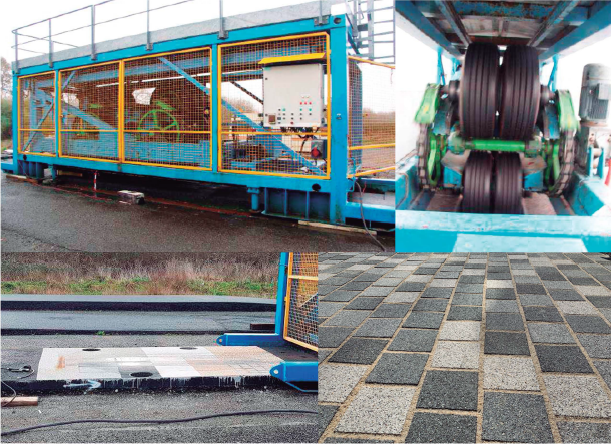
There are figures that impress. And then there are those that force you to stop for a few seconds to try to imagine them. Three million passes belong to that second category. Byond's technical documentation records a comparative test in which ten coatings were subjected to three million passes using the FABAC simulator.
The scene has something hypnotic about it. The wheels travel exactly the same path over and over again. Not once, not a hundred, not a thousand: millions of times, always over the same section. Because wear rarely needs grand gestures to appear. It is built by thousands of small actions repeated over and over.
Each pass adds a tiny piece of information. Each cycle allows us to observe how the material responds. Each repetition brings us a little closer to the answer engineering has been looking for for decades. Not how much a pavement resists, but how it ages. And that difference changes everything.

FABAC does not try to break a pavement
There is a fairly widespread misconception: thinking that this type of testing seeks to destroy a material until it fails. In reality it is the opposite. FABAC, developed within what is now the Gustave Eiffel University, is a simulator designed to study the behaviour of pavements under repetitive traffic in controlled conditions, allowing solutions to be compared and their evolution better understood.
The machine is not looking for a spectacle. It is looking for answers. It does not try to prove who wins: it tries to understand why some materials respond one way and others another. Because engineering does not work with intuitions. It works with evidence.
The most important thing was not reaching three million
It would be easy to keep only the number. But doing so would lose sight of what matters. What really matters happens when the test ends. When the moment comes to compare, to observe, to measure.
According to the conclusions gathered in Byond's technical documentation, nine of the ten samples did not show a significant evolution of their final characteristics and, during the loading phases, no degradations were observed according to the criteria defined in the study.
That result belongs exclusively to the conditions of the test. It does not mean that any pavement will behave the same way. It does not automatically turn three million passes into a decades-long guarantee. It does not eliminate the influence of climate, substrate, execution or maintenance. But it does prove something enormously valuable: that resistance can be studied, and that a technical decision can rely on knowledge, not just on promises.
The difference between building and building well
Cities are not built for opening day. They are built for all the days that come after.
For the winters, the summers, the festivals, the markets, the bicycles, the buses. For the generations that will use that space without ever asking who chose that pavement. Perhaps that is the greatest success of a piece of infrastructure: that no one has to think about it, because it simply keeps working.
The philosophy behind Zoruflex
Understanding how a pavement ages also changes the way it is designed. That is why the development of solutions such as Zoruflex cannot be understood solely from the surface finish. Its approach starts from a much broader idea: designing with real use in mind.
That means, when the existing substrate allows it, opting for rehabilitation without major demolition, taking advantage of infrastructure that has already been built and reducing the waste generated by removing a pavement that can still keep providing service. It also incorporates recycled glass in its formulation and is oriented to urban applications where behaviour under continued use is especially relevant, always within the conditions for which each system has been designed.
It is not just about building a surface. It is about making a good decision for the city. Because a pavement accompanies the daily life of thousands of people for much longer than construction lasts.
The best infrastructure is the kind no one remembers
In a few years someone will cross that plaza again. They probably won't remember when it opened, or which company built it, or which system was used. They will simply walk. And perhaps that is the greatest recognition a piece of infrastructure can receive: to go unnoticed because it keeps fulfilling exactly the function it was designed for.
Behind that apparent normality there are hundreds of invisible decisions: research, testing, comparisons, mistakes caught before reaching the site. And a conviction that should accompany any urban project: the resistance of a pavement does not begin when it bears the first wheel. It begins much earlier, when someone decides that the future cannot be left to chance.
Frequently asked questions about pavement resistance
- What exactly is an Accelerated Pavement Test (APT)?
- It is a methodology in which a simulator reproduces, under controlled conditions, millions of loads on a pavement section to observe how its behaviour evolves without having to wait years of real use. It is used by universities, research centres and public bodies to compare solutions and reduce uncertainty in decision-making.
- Do three million passes equal a decades-long guarantee?
- No. The results of an accelerated test belong to the specific conditions of that test. They provide very valuable evidence of how a material evolves under repetitive use, but a pavement's real service life also depends on climate, existing substrate, on-site execution and maintenance.
- What makes Zoruflex different from a conventional pavement?
- Zoruflex is conceived as a seamless system designed for the real use of the city: when the substrate allows it, it can be applied over existing pavements avoiding demolition, it incorporates recycled glass in its formulation and it is oriented to urban applications where behaviour under continued use is especially relevant.
Zoruflex is a seamless system designed to accompany the real life of a city. Tell us about your project and we'll help you decide the best solution.
Talk to the technical team →