
Smart rehabilitation starts with a different question
We're used to thinking that renovating means starting from scratch. A pavement deteriorates, cracks appear, tiles wear down, the surface loses uniformity. And almost automatically we imagine the same process: lift, demolish, remove rubble, bring new materials and build again.
For decades, that has been the usual way of tackling the rehabilitation of many public spaces. But today it's worth asking a different question.
What if the pavement could still be part of the solution?
It's not purely economic or purely technical. It's a question about how we understand construction at a time when every tonne of material, every transport trip and every waste count more than ever.
Maybe the smartest rehabilitation isn't the one that builds the most. Maybe it's the one that best takes advantage of what already exists.
The most sustainable project is the one that doesn't need to start from scratch
When we talk about sustainability in construction we usually think immediately of recycled materials, renewable energy or efficient buildings. However, there's a much less visible side with a huge impact: waste.
The European Commission estimates that construction and demolition waste represents more than a third of all waste generated in the European Union. It's a huge figure. But behind that data there is an even more interesting reflection.
The best waste is the one that is never produced.
That's why the circular economy is no longer limited to recycling materials. Its first question is much simpler: what can we preserve before deciding to demolish?
Demolition isn't always the only answer
This doesn't mean a pavement never needs to be replaced. There are situations where the substrate has completely lost its structural capacity and reconstruction is unavoidable.
But there are also many cases where the problem isn't in the base. It's on the surface:
- In the wear caused by time.
- In exposure to the environment.
- In the ageing of the finish.
When the structure is still sound, complete demolition can stop being a necessity and become simply a habit. And that's precisely where engineering and innovation start to change the way we intervene.
Building can also mean recovering
For a long time we've associated construction innovation with erecting taller buildings or developing stronger materials. Today innovation also means intervening better.
- Extending the service life of an infrastructure.
- Reducing unnecessary interventions.
- Making use of resources that can still fulfil their function.
Rehabilitation then stops being understood as a simple repair. It becomes an optimisation strategy. Not only of space, but also of resources.
Avenida de Sardinas: a different way to intervene
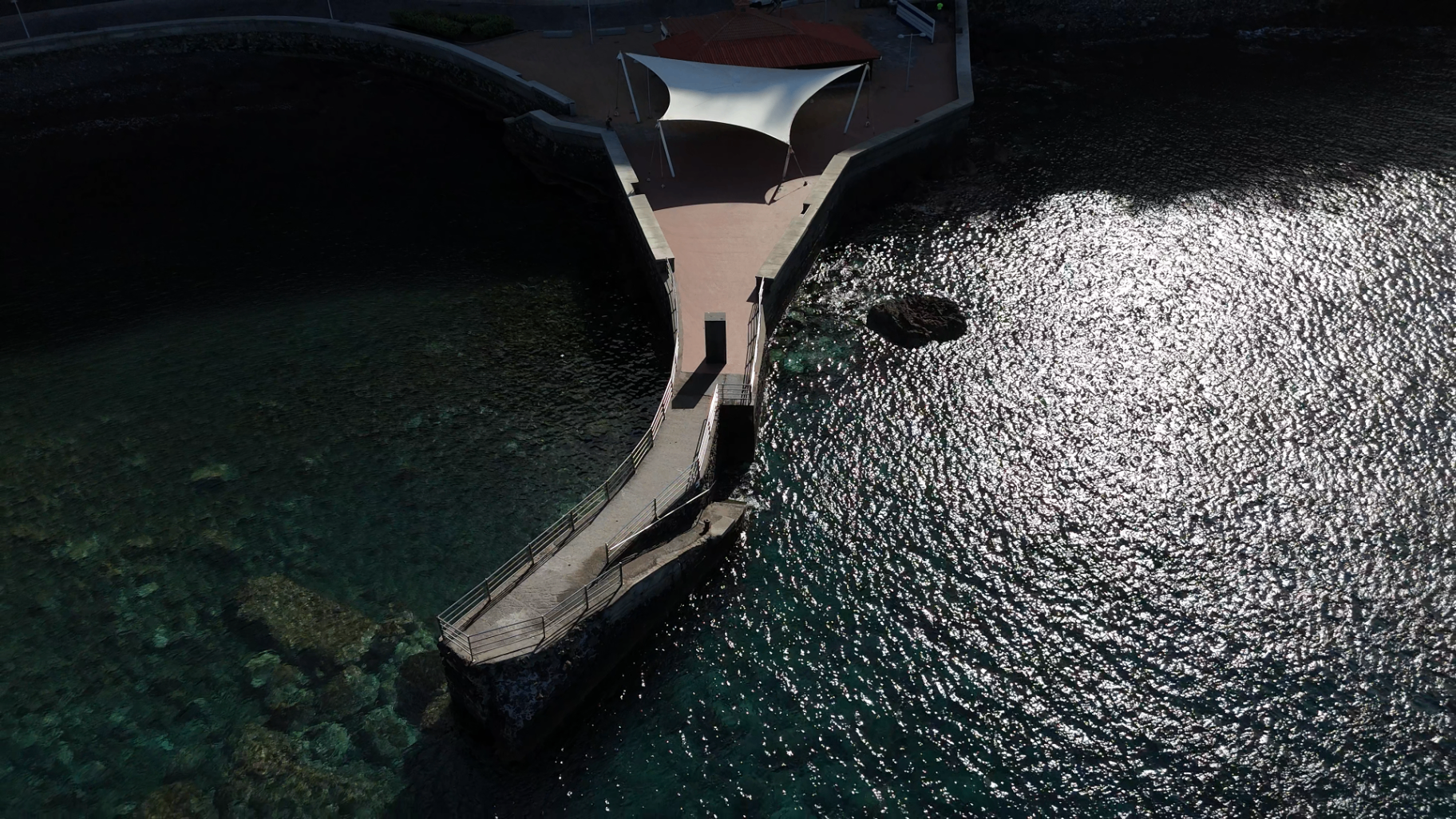
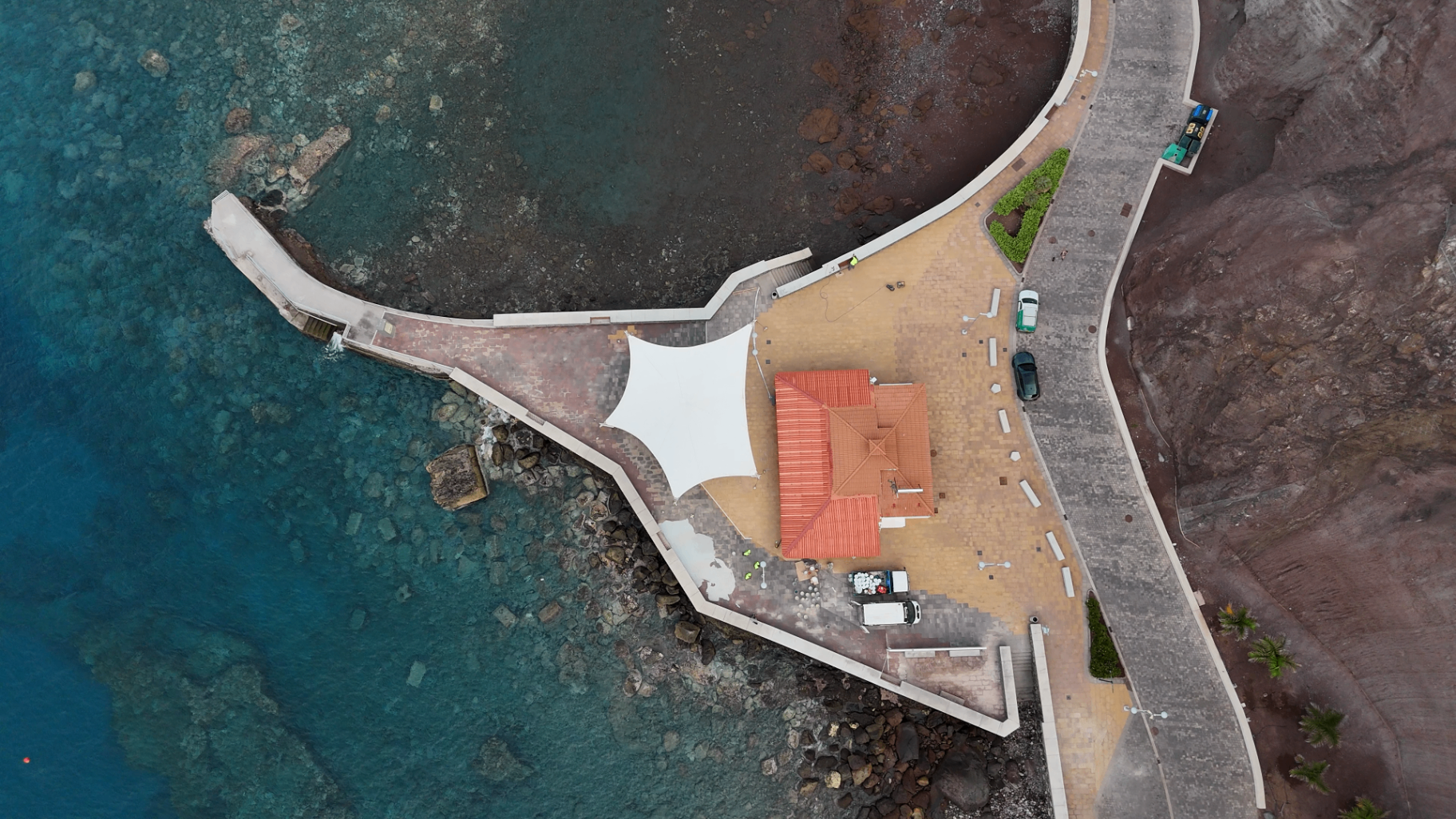
On Avenida de Sardinas, in the municipality of Gáldar (Gran Canaria), there was a public space heavily exposed to the marine environment. As happens in many coastal areas, time had left its mark.
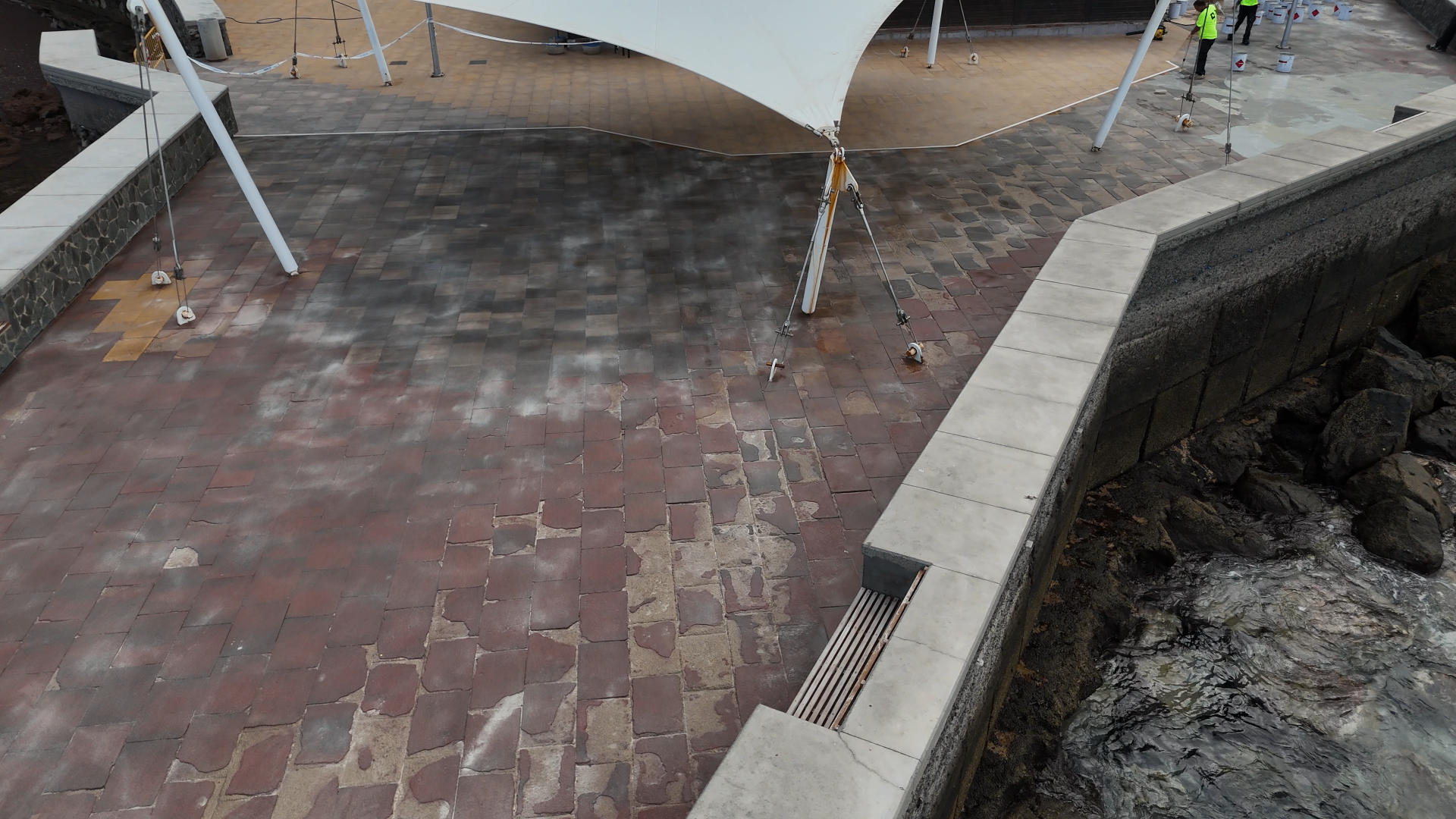
The tiles showed surface wear, loss of material in numerous pieces, chipping and saline efflorescence typical of an environment constantly exposed to the sea.
The traditional response would have been simple: lift the entire pavement, remove tonnes of material, prepare a new base and start over. However, the approach was different.
Before deciding what to build, we analysed what could be preserved.
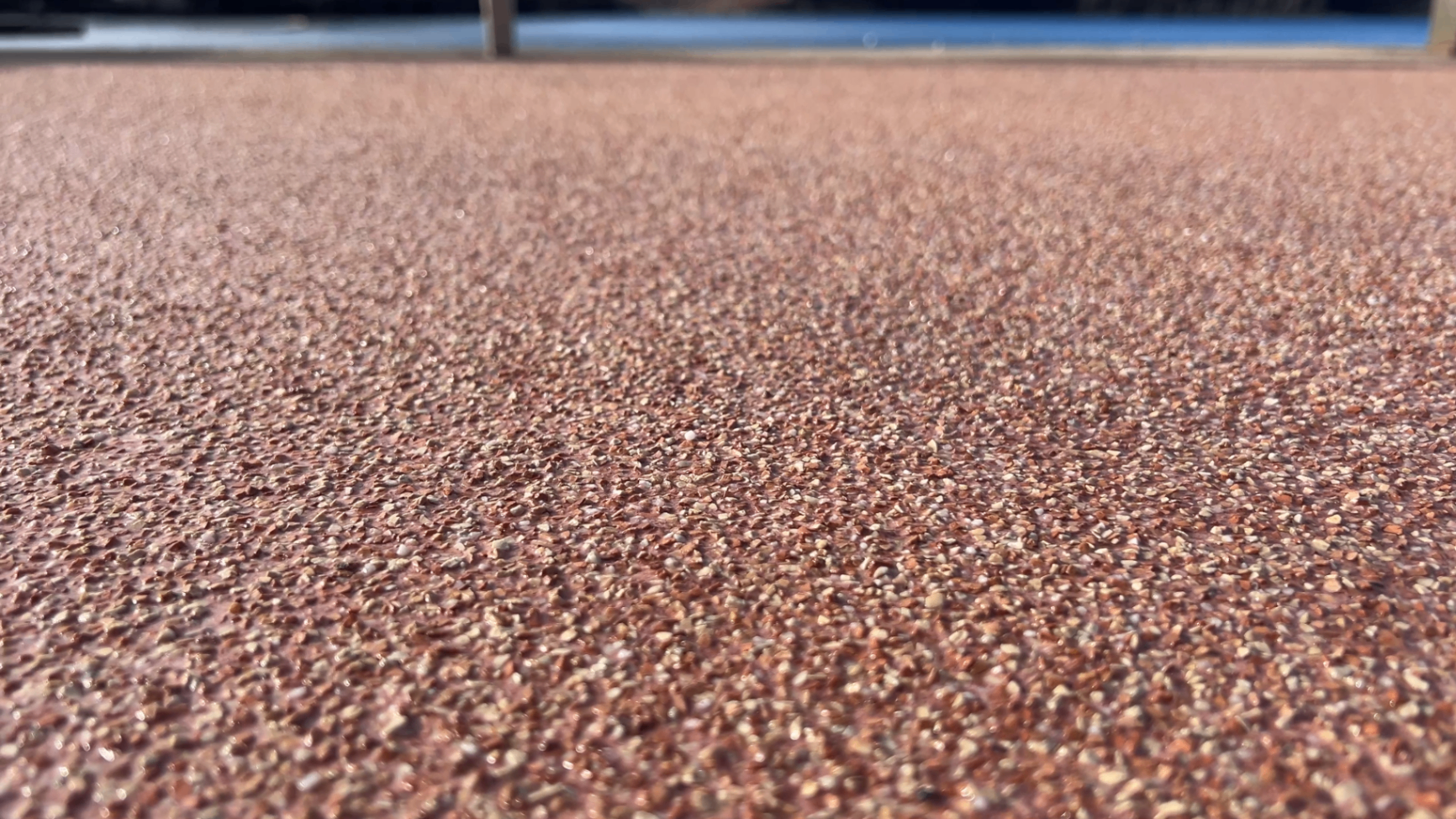
After technical preparation of the substrate —including mechanical polishing, cleaning, priming and levelling of joints and damaged pieces— it was possible to install a new seamless Zoruflex system in coral colour over the existing base, over a total surface of 380 m².
The intervention didn't start by destroying. It started by evaluating. And that difference completely changes the logic of the project.
The sustainability that is almost never seen
When someone walks through a rehabilitated space they usually notice the finish: the colour, the texture, how the place has changed visually. But they rarely think about everything that didn't happen.
- The existing pavement didn't need to be completely removed.
- The whole surface didn't need to be turned into demolition waste.
- It wasn't necessary to rebuild from a completely new base.
And although each project requires specific study and not every substrate allows this type of intervention, when it is technically viable a very interesting opportunity appears: rehabilitating without wasting what still works.
Innovating doesn't always mean adding more. Sometimes it means removing less.
There's a very clear trend in contemporary architecture. There is more and more talk of reuse, rehabilitation, smart conservation and circular economy.
Because the future of construction probably won't depend only on manufacturing better materials. It will also depend on making better decisions. The first of them tends to be the hardest: asking whether it's really necessary to start from scratch.
Zoruflex and a new way of understanding rehabilitation
This philosophy is very present in the development of Zoruflex. Beyond its formulation, which integrates recycled glass into its composition, the system starts from a simple idea:
Every project should be analysed to understand what can be recovered, what needs repair and what really requires replacement.
When substrate conditions allow it, intervening on the existing base can be part of a more efficient strategy from a technical, functional and resource-management standpoint.
It's not just about applying a new coating. It's about understanding the space as a whole, valuing what still has useful life and acting only where it's really necessary.
The construction of the future will demolish less and think more
Construction has always been about creating. But maybe the next big step isn't to build more, but to build with better judgement.
- Every pavement that can still be useful.
- Every substrate that still retains its capacity.
- Every intervention that avoids an unnecessary demolition.
It represents an opportunity to move towards smarter construction. Not because sustainability is a trend, but because resources are limited. And because the best innovation isn't always about inventing something new.
Sometimes it simply means looking at an existing project and asking a different question: what if, instead of starting from scratch, we started by using what already works?
Final thoughts
Pavement rehabilitation is changing. It's no longer just about renewing the image of a public space. It's about making more efficient, more conscious decisions better adapted to the real needs of each project.
The case of Avenida de Sardinas shows that, when the substrate allows and a prior technical analysis exists, it's possible to plan interventions that extend the useful life of the space without automatically resorting to full demolition.
Because the smartest construction doesn't always leave a bigger mark. Sometimes, precisely, it means leaving less.
FAQ about pavement rehabilitation without demolition
- Is it always necessary to demolish to renew a pavement?
- No. When the substrate retains its structural capacity and the deterioration is concentrated on the surface, it's possible to intervene on the existing pavement with seamless systems such as Zoruflex, after adequate technical preparation (polishing, cleaning, priming and joint levelling).
- When is it mandatory to demolish the existing pavement?
- When the substrate has lost structural capacity, shows significant settling, base failures or damage that prevents guaranteeing the adhesion and stability of the new system. That's why every project requires a prior technical study of the real state of the substrate.
- What are the advantages of rehabilitating without demolishing?
- It reduces construction and demolition waste, cuts down transport and consumption of new materials, shortens construction times and minimises disruption to the use of public space. It also fits the principles of the circular economy applied to construction.
- Can Zoruflex be applied over existing tiles?
- Yes, provided the tiles maintain adequate adhesion to the substrate and specific technical preparation is carried out: mechanical polishing, cleaning, priming and levelling of joints and damaged pieces. Avenida de Sardinas, in Gáldar, is a real example of this type of intervention.
- What exactly was done on Avenida de Sardinas (Gáldar)?
- 380 m² of pavement were rehabilitated by applying coral-coloured Zoruflex directly over the existing tiles, after technical preparation of the substrate. The intervention allowed the surface to be completely renewed without demolishing the previous pavement.
Discover Zoruflex, the seamless system that allows existing pavements to be rehabilitated without demolition when the substrate permits.
See Zoruflex solutions →